

This paper reports the development of APRIL, an automated robotic system for embryo culture dish preparation.
The team built the system on a commercial liquid-handling platform. Custom adapters and control algorithms enabled precise medium distribution and improved consistency. The study covered technical development through preliminary clinical validation.
Automating some routine repetitive operations in assisted reproductive laboratories has long been a goal of many research teams and companies. The system may not represent the final form of this technology. However, its achievements and research methods offer useful guidance for future work.
The system still has important limitations. It supports only specific culture-dish models, and some steps require manual supervision. Overall, this study provides a feasible path for automating IVF laboratories. Its clinical application effects need to be further verified in larger-scale studies.
Research Background
IVF success depends on precise control of the embryo culture environment. Culture-dish preparation is a crucial part of that process.
Manual preparation is time-consuming and labor-intensive. Operator variability and fatigue can also affect droplet volume, pH, and other key parameters. This in turn affect embryo development.
Demand for assisted reproduction is growing while embryologist shortages are becoming more severe. Laboratories therefore need tools that improve efficiency and reduce human error.
The study developed and validated the ART Pipetting Robot for the IVF Laboratory (APRIL). Its standardized workflow was designed to improve embryo culture-dish preparation. This provides more stable and efficient technical support for IVF laboratories.
Research Methods
APRIL uses the Opentrons OT-2 liquid-handling platform. Custom 3D-printed adapters support high-precision preparation of microdroplet culture dishes.
The system has two robotic arms. One uses a P300 single-channel pipette to dispense 25 µL of culture medium. The other uses a P1000 single-channel pipette to add 5 mL of mineral oil.
All contact materials passed the mouse embryo assay (MEA) for toxicity. A high-efficiency air-filtration module helps maintain a clean internal environment.
The study used a prospective randomized controlled design. It compared APRIL-prepared and manual dishes for droplet quality, pH stability, and embryo development.
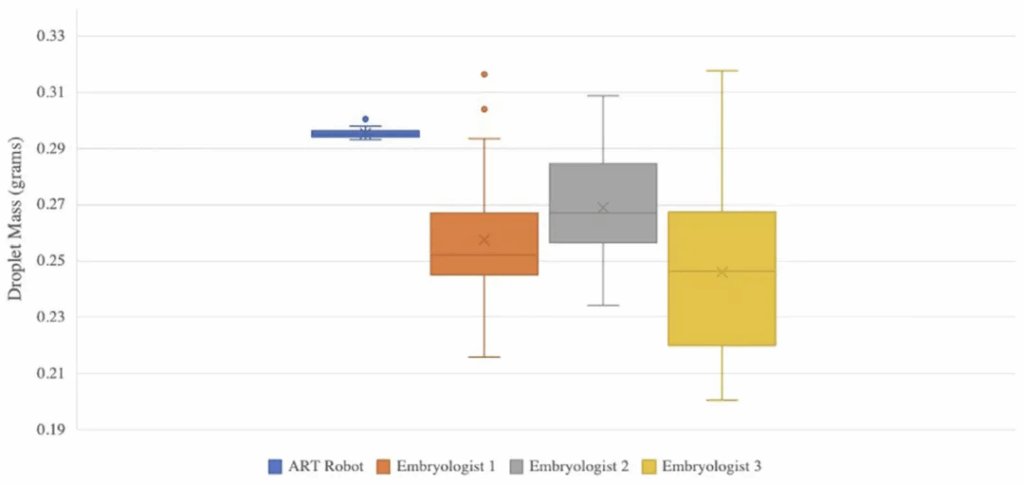
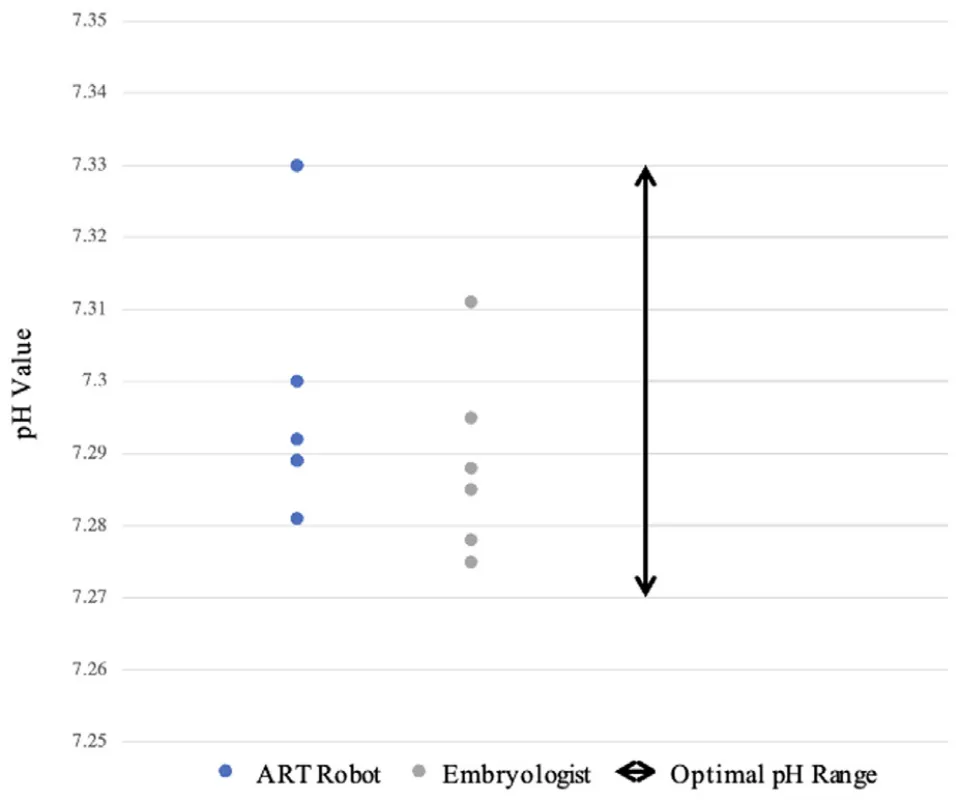
Researchers analyzed weighing data from 30 robot-prepared dishes and 90 manually prepared dishes. They calculated the coefficient of variation (CV) to assess consistency. For pH testing, researchers compared both groups after overnight culture. They measured changes in dishes prepared by the robot and by hand.
Embryo assessment included mouse blastocyst formation and human embryo development on days 3 and 5. These measures tested the system’s reliability and clinical applicability.
Research Results
APRIL achieved a droplet-mass coefficient of variation of only 0.46%. Manual preparation showed a much higher variation of 6%–7%. This indicates high consistency. Robot-prepared dishes maintained a pH of 7.281–7.33. Manual dishes measured 7.275–7.311. Both ranges were suitable for embryo culture.
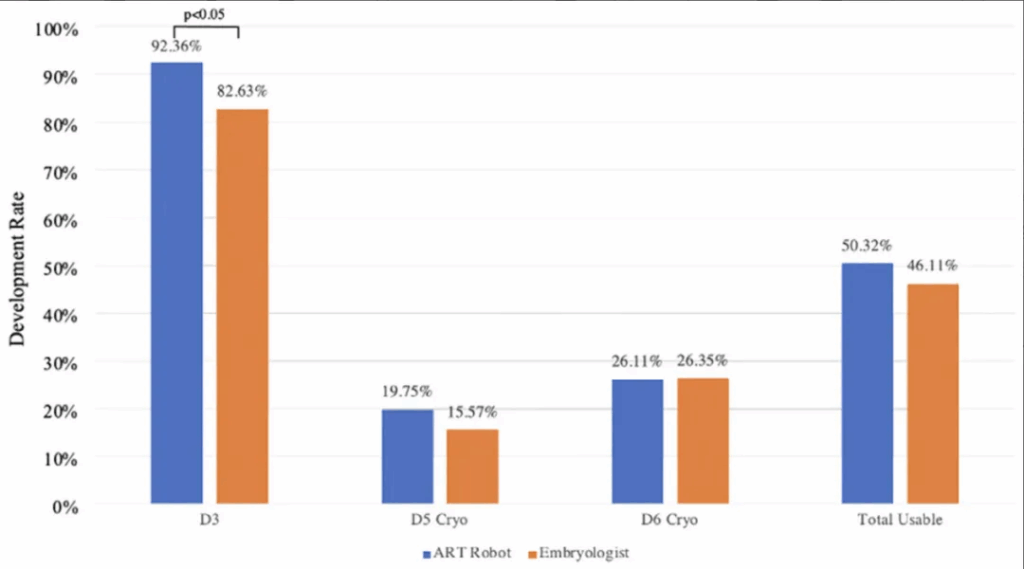
In mouse embryo experiments, the blastocyst formation rate in the APRIL group reached 100%, slightly higher than the 90%–91% in the manual group. Data on human embryo culture showed that the day 3 embryo development rate in the robot group was significantly higher (92.4% vs. 82.6%), and the day 5 blastocyst rate (19.75% vs.
15.57%) and total number of usable embryos (50.3% vs. 46.1%) also increased, though the latter two differences did not reach statistical significance. These results indicate that the automated system can provide a more stable culture environment and may have a positive impact on embryo development.
Research Innovations
The innovations of APRIL mainly lie in technical design and application safety. Technically, the system is the first to apply automated liquid handling technology to the preparation of human IVF culture dishes.
Through custom 3D-printed adapters and optimized control algorithms (such as dynamically adjusting pipetting depth to avoid bubble formation), it achieves far higher precision and repeatability than manual operations.
In terms of safety, all contact materials of APRIL have passed rigorous embryo toxicity testing. Its operation process does not directly involve human gametes or embryos. This reduces the risk of contamination or damage.
In addition, the system can handle 20 culture dishes at a time, significantly improving laboratory efficiency, saving valuable time for embryologists, and allowing them to focus on other key steps that require more manual intervention.
Research Limitations
Despite its many advantages, APRIL has certain limitations. First, the system is currently only compatible with a specific model of culture dish (Vitrolife 16003). If laboratories use dishes from other brands, adapters and control codes need to be redesigned and adjusted. This limits its universality.
Second, although APRIL can independently complete most operations, manual supervision is still required to ensure correct loading of consumables (such as culture medium, mineral oil, and pipette tips), and full automation has not yet been achieved.
Furthermore, the sample size of human embryo research is relatively small (324 embryos), and some results (such as the day 5 blastocyst rate) did not reach statistical significance. Larger-scale clinical studies are needed in the future to further verify its long-term benefits.
Clinical Significance and Prospects
The introduction of APRIL provides IVF laboratories with a standardized and reproducible culture dish preparation protocol. Its high precision and stability are expected to improve the embryo culture environment, thereby enhancing clinical pregnancy rates.
Especially for high-throughput laboratories, automated technology can significantly reduce the workload of embryologists, minimize batch-to-batch variations caused by human errors, and may reduce additional treatment costs due to improper operations.
Although its current functions are limited, the successful validation of APRIL lays a foundation for expanding automated technology to other key IVF steps (such as sperm injection or embryo transfer) in the future.
Moreover, against the backdrop of global embryologist shortages, the promotion of such technologies helps alleviate the strain on human resources. This provides timely and efficient treatment options for more infertile patients.
reference
Lattin MT, Djandji AS, Kronfeld MT, Samsel T, Ling R, Ciskanik M, Sadowy S, Forman EJ, Williams Z. Development and validation of an automated robotic system for preparation of embryo culture dishes. Fertil Steril. 2024 Aug;122(2):297-303. doi: 10.1016/j.fertnstert.2024.04.016. Epub 2024 Apr 15. PMID: 38631505.